
Harnessing Scenario Planning to Build Resilient Organisations
The organisations that stumble in the next few years won’t be the ones that predicted the future wrong. They’ll be the ones that planned for only one version of it.
HR scenario planning is becoming essential as economic volatility, skills scarcity, regulatory change and AI reshape workforce strategy at unprecedented speed. Yet, many organisations are still clinging to annual headcount plans, static role definitions and linear growth assumptions – relics of a more predictable era.
Research consistently shows that organisations investing in future readiness significantly outperform their peers in profitability and growth. The question, then, is no longer whether HR can predict the future. It’s whether HR is equipping the organisation to survive and adapt as the future unfolds.
The Reality HR Leaders Are Navigating Today
HR leaders are being asked to make long-term decisions in conditions defined by uncertainty:
- Hiring needs shift faster than budgets can be approved, forcing leaders to act with agility.
- Critical skills emerge before organisations are ready to develop them, creating talent gaps that demand proactive planning.
- Entire job families are reshaped by technology, transforming roles and career paths at an unprecedented pace.
- Regulatory or economic changes can redefine priorities overnight, leaving little room for reaction.
In this context, the question has evolved.
It is no longer, “What will the workforce look like?”
It is “What if the future doesn’t unfold the way we expect?”
What Is HR Scenario Planning?
HR scenario planning is a strategic workforce planning approach that helps organisations prepare for multiple plausible future workforce scenarios rather than relying on a single forecast.
Traditional forecasting asks, “What will happen?”
Scenario planning asks, “What could plausibly happen – and are we ready for all of them?”
For HR leaders, this shift represents more than a methodological change. It’s a critical risk management and resilience capability. By applying scenario planning, leadership teams can:
- Explore multiple realistic workforce futures, anticipating shifts in skills, roles and structures before they materialise.
- Stress-test strategic decisions, ensuring initiatives remain viable across a range of possible outcomes rather than a single forecast.
- Identify vulnerabilities early, revealing gaps in skills, capacity or processes that could undermine performance if left unaddressed.
Embedded into HR strategy, scenario planning moves the organisation from reactive workforce adjustments to deliberate, future-ready design.
How HR Leaders Can Start Scenario Planning
HR scenario planning doesn’t require perfect data or complex modelling. A pragmatic, structured approach can deliver significant value through five key steps:
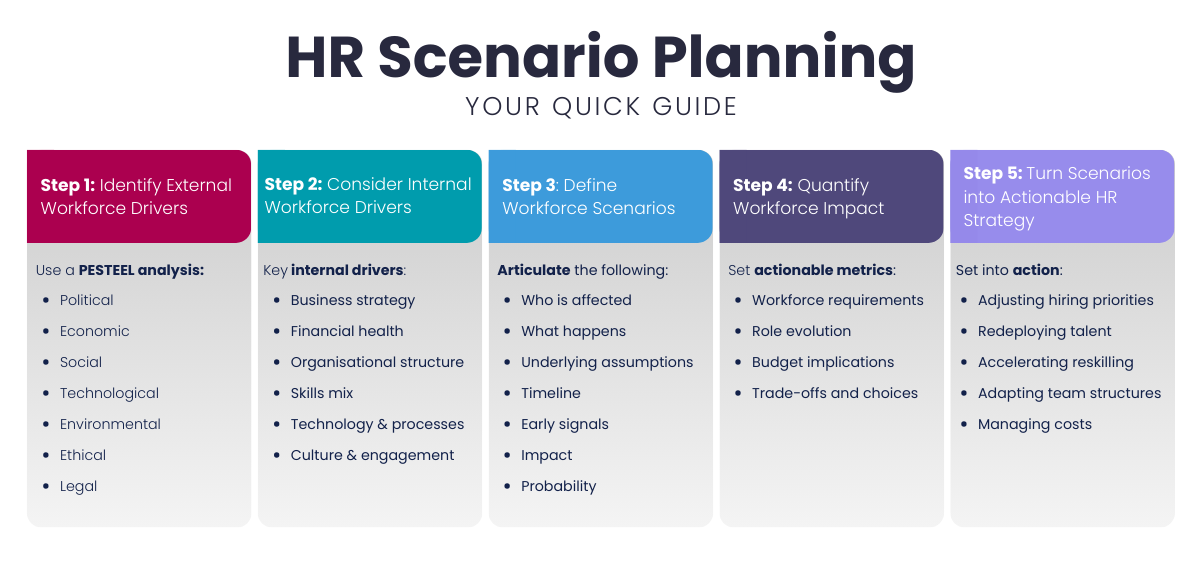
Step 1: Identify External Workforce Drivers
Use a PESTEEL analysis to shape realistic workforce scenarios, ensuring it reflects real-world forces, not assumptions.
- Political: Policy shifts affecting hiring, immigration or employment law
- Economic: Market volatility, recessions or growth cycles influencing workforce demand
- Social: Changing employee expectations around flexibility, purpose and well-being
- Technological: Automation and AI reshaping roles and skills requirements
- Environmental: Climate risks impacting locations, remote readiness and sustainability goals
- Ethical: Fairness, transparency and responsible use of data, AI and surveillance in workforce decisions
- Legal: New labour regulations affecting pay, benefits and employment practices
Step 2: Consider Internal Workforce Drivers
External forces interact with internal realities. Key internal drivers typically include:
- Business strategy: New markets, products or acquisitions that change talent needs fast
- Financial health: Budgets and revenue directly limiting hiring or forcing freezes
- Organisational structure: Leadership gaps that slow scaling
- Skills mix: The balance between permanent, contingent, critical and at-risk skills
- Technology and processes: Weak systems reducing speed and flexibility
- Culture and engagement: Low change readiness making transformation harder
Together, these drivers shape the boundaries of what is possible for the workforce.
Step 3: Define Workforce Scenarios
To capture the full range of possibilities and add nuance, consider exploring up to five variations – such as possible, plausible, probable, preferred and targeted – so that each scenario reflects different degrees of impact and likelihood.
Each scenario should clearly articulate:
- Who is affected: The teams, roles or departments impacted by the scenario
- What happens: The key events or triggers that set the scenario in motion
- Underlying assumptions: The conditions driving the scenario, such as projected revenue changes, AI adoption rates or regulatory shifts
- Timeline: The expected progression across the near, mid and long term
- Early signals: Measurable indicators or trends that suggest the scenario is beginning to unfold
- Impact: The potential effects on headcount, skills requirements, locations and budgets
- Probability: A reasoned estimate, informed by available data, of how likely the scenario is to occur
By systematically defining these elements, organisations can ensure scenarios are actionable, measurable and directly tied to strategic decision-making.
Step 4: Quantify Workforce Impact
Translate each scenario into actionable metrics to guide decision-making:
- Workforce requirements: How many people will be needed to meet future demands?
- Role evolution: Which roles are likely to expand, contract or transform?
- Budget implications: What resources will be required for salaries, training and development?
- Trade-offs and choices: Should the organisation upskill existing staff, hire new talent or a combination of both?
By quantifying the impact, HR leaders can move from abstract possibilities to concrete plans, ensuring that strategy and resources are aligned with potential futures.
Step 5: Turn Scenarios into Actionable HR Strategy
With scenarios modelled, define clear response plans. These may include adjusting hiring priorities, redeploying talent, accelerating reskilling, redesigning team structures or managing costs while protecting operational performance.
Crucially, establish clear triggers – predefined signals or thresholds that indicate when a specific plan should be activated.
Preparing For More Than One Future
HR scenario planning is no longer optional for organisations navigating uncertainty. Leaders who invest in strategic workforce planning today are better positioned to adapt, respond and thrive tomorrow.
Key Sources
Veldsman, D. AIHR. Scenario Planning: What HR Needs to Know.
World Economic Forum. (2025). How interactive ‘Scenario Game’ helps navigate uncertainty and develop foresight.
HRM Guide. Scenario Planning & Workforce Resilience.
Trisca, L. (2025). Scenario Planning in HR: A Beginner’s Guide to Building Flexible, Future-Ready Teams.