
For many HR professionals in South Africa, the term “Agentic AI” sounds like something straight from a Silicon Valley boardroom – impressive but perhaps disconnected from the daily realities of managing a local workforce. Between navigating complex labour laws, managing talent shortages, and handling the administrative weight of compliance, the idea of “autonomous digital agents” can feel daunting.
However, as leading companies such as McKinsey & Co and Mercer suggest, we are moving past the era of “chatting” with AI and entering the era of “doing” with AI.
“The question isn’t whether jobs will survive AI, but whether organisations are evolving fast enough to keep the jobs they have, and the people they want.” Valter Adao, CEO of Cadena Growth Partners
In the South African context, the goal isn’t to build a sci-fi HR department. It’s about understanding the spectrum of AI technologies and identifying exactly where they can solve your unique challenges. Here is a structured way to think about AI use cases in HR, moving from basic automation to strategic agency.
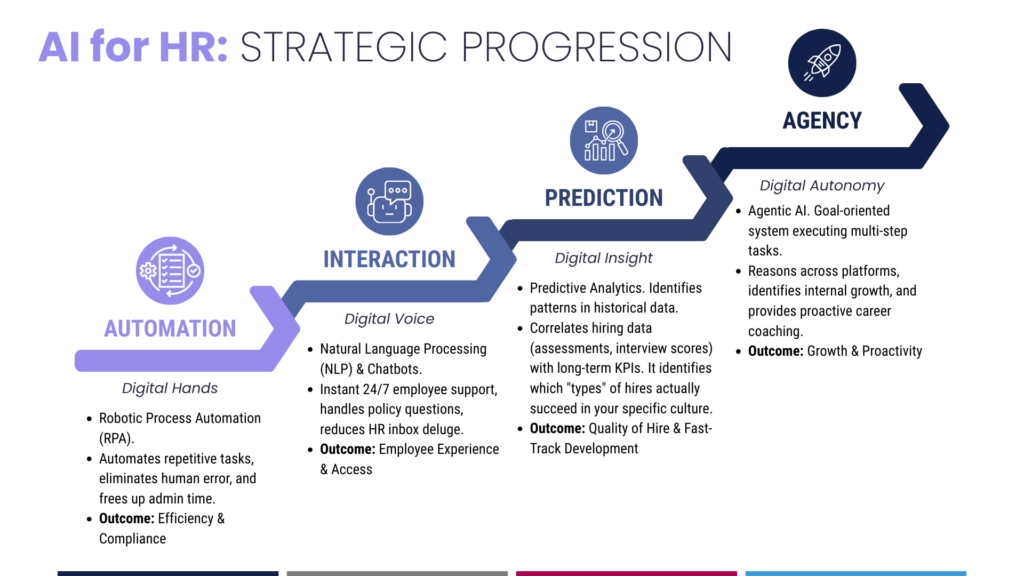
- Automation is The Foundation
1.1 Robotic Process Automation (RPA)
Think of this as the “digital hands” of HR. Robotic Process Automation (RPA) doesn’t “think” – it follows a set of rules perfectly and tirelessly. In South Africa, where HR teams are often lean and compliance-heavy, this is the quickest win.
Instead of an HR officer spending three days compiling data for Employment Equity (EE) reports or internal compliance audits, RPA can pull data from payroll and attendance systems, populate the forms, and flag discrepancies instantly.
It eliminates human error in high-stakes reporting and frees up hours of administrative time.
2. Interaction Enables Access
2.1 Natural Language Processing (NLP) and Chatbots
This is the “digital voice”. It allows employees to interact with company systems using natural language rather than navigating complex menus or sending emails.
Most HR teams spend 30% of their time answering the same questions, “How much leave do I have left?” or “How do I claim overtime?” A localised chatbot can be trained on your company’s specific handbook to provide instant, 24/7 answers.
It provides immediate employee gratification and stops the HR “inbox deluge”, allowing practitioners to focus on complex employee relationships that require empathy.
3. Prediction Drives Strategy
3.1 Predictive Analytics
Predictive AI uses historical data to identify patterns and suggest what might happen next. In a country where skills are scarce and the “brain drain” is a reality, this is a strategic necessity.
By analysing patterns – such as commute distances, time since last promotion and engagement scores – AI can flag “high-potential” employees at risk of resigning. This allows HR to intervene with a stay interview or a retention plan before the resignation letter hits the desk.
It shifts HR from being reactive (hiring when someone leaves) to proactive (keeping the talent you already have).
4. Agency Enables Autonomy
4.1 Agentic AI
Unlike a chatbot that waits for a question, an AI agent is given a goal and determines the steps to achieve it. It can “reason” across different software systems.
What is Agentic AI? Agentic AI is a goal-oriented system that can execute multi-step tasks autonomously across different software platforms.
Often, great talent is “hidden” in different departments. An AI agent can act as a career coach that proactively looks for internal growth opportunities.
How it works: The AI agent continuously maps a Junior Software Developer’s evolving skill set against the organisation’s future talent requirements. When it identifies a gap – such as an upcoming mid-level opening – it cross-references the developer’s recent AWS certifications and performance data. Instead of waiting for a manual review, the agent proactively reaches out, “Based on your latest milestones and technical growth, you’ve met the criteria for an upcoming mid-level role. Would you like to explore this internal move?” The value lies in driving retention by having the data in your system “speak” to the employees’ career goals.
Making It Work
The South African HR context requires a specific approach to these technologies. We cannot simply “plug and play” global solutions. To succeed, local HR leaders could focus on three pillars:
1. Data Hygiene First
AI is a “garbage in, garbage out” system. Before moving to Predictive or Agentic AI, ensure your employee data (from ID numbers to skill sets) is clean, digitised, and centralised. In the 2026 landscape, this isn’t just about technical organisation – it’s also about POPIA alignment.
2. The Ethics of Equity
In our local context, we must be vigilant about algorithmic bias. HR must ensure that AI tools are regularly audited to prevent them from unfairly disadvantaging certain groups during recruitment or performance reviews.
3.The Human Touch
The goal of Agentic AI is not to replace the HR Manager, but to “liberate” them. The time saved from scheduling and reporting should be reinvested into what AI cannot do: coaching, conflict resolution, and building a high-performance culture.
The leap to Agentic HR doesn’t happen overnight. It starts with automating the mundane, predicting the future, and eventually reaching a point where AI handles the process, allowing humans to be more relationship-focused. Hence, integrating AI isn’t just a technical upgrade – it’s also a policy evolution.
Signify’s Talent Management System
Signify has embarked on a journey to embed AI directly into our platform as a built-in capability designed to support users, managers, and administrators in their everyday work. Our goal is simple: to make AI practical, accessible, and genuinely useful.
Book a demo to see how Signify can support your HR team:
Key Sources
CHRO South Africa. (2026). HR meets AI: Rethinking the workforce strategy for 2026
Deloitte. (2026). Human capabilities are at the heart of high-performing teams.
Josh Bersin Company. (2026). The Rise of the Superworker: Four Stages of AI
McKinsey & Company. (2025). One year of agentic AI: Six lessons from the people doing the work
Mercer. (2025). Defining Tech in 2025 – AI Agents.